The Escalator's Two-Speed Budget: Why Walking Left Can Cost the Queue
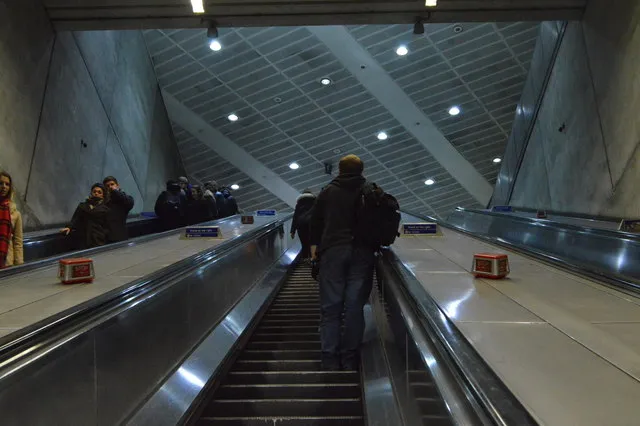
Photo: N Chadwick , CC BY-SA 2.0, via Wikimedia Commons
At 8:42 on a weekday morning, the escalator at Oxford Circus has a social contract printed on it in invisible ink: stand on the right, walk on the left. It feels efficient. It feels fair. It also feels like exactly the sort of city habit that deserves a quick algebraic audit.
Because an escalator is not one machine. It is two lanes sharing a moving staircase, and each lane has its own speed, its own crowd density and its own way of making a mess at the top. If you want to know whether walking left actually shifts more people, you need to compare two products: people per metre and metres per second.
Two lanes, two products
Start with the standing lane. Suppose the escalator is 30 metres long and each lane is about half a metre wide. In the standing lane, people are packed fairly closely: call it 1.2 people per metre of lane length. The escalator itself moves at roughly 0.5 metres per second. Throughput is density times speed:
standing lane: 1.2 × 0.5 = 0.6 people per second
Now the walking lane. Walkers leave bigger gaps because they need room to step. Call that 0.4 people per metre. They add their own walking speed to the escalator, so the combined speed might be 1.1 metres per second. That gives:
walking lane: 0.4 × 1.1 = 0.44 people per second
So the walking lane moves fewer people per second than the standing lane, even though each walker is moving faster. That is not a paradox. It is queue arithmetic. The walking lane wins on individual speed and loses on spacing.
If both lanes stood, the whole escalator would carry about 1.2 people per second. If one lane stands and one lane walks, it carries about 0.6 + 0.44 = 1.04 people per second. The split has reduced total throughput by roughly 0.16 people per second — about ten people a minute. At a busy station, that is not a rounding error.
But the walking lane can earn its keep. If the walking lane gets denser — say 0.8 people per metre because the crowd is tight but still moving — then its throughput becomes 0.8 × 1.1 = 0.88 people per second. The split now carries 1.48 people per second against 1.2 for all-standing. Walking left is a genuine throughput upgrade, provided the walkers can still walk.
That last condition matters. As the walking lane fills, speed falls. People shuffle, stop, restart. The walking lane becomes a standing lane with extra anxiety.
The top landing is the referee
Lane products are only half the story. Every escalator ends at a landing, and the landing has an exit capacity. Call it C: the number of people per second that can actually leave the top without a pile-up. Then subtract a merge friction term, f, because walkers arriving from the left have to blend into the standing queue at the top. The effective throughput of the split is:
min(standing lane + walking lane, C − f)
If the lane total is below C − f, the escalator is the constraint. If the lane total is above C − f, the top landing is the constraint. The extra speed of the walking lane does not vanish; it just relocates the queue from the bottom of the escalator to the top.
Put numbers on it. Suppose the top landing can clear 1.1 people per second, and merge friction costs 0.12 people per second. That leaves 0.98 people per second of usable exit capacity. Our split lane total of 1.48 is irrelevant: the effective throughput is 0.98. All-standing would have delivered 1.2. The walking lane has made the system slower, because it has fed a bottleneck.
Now imagine a quieter station, or a later hour. Exit capacity is 1.6 people per second, merge friction is 0.05, so usable capacity is 1.55. The split total of 1.48 fits underneath. The walking lane now helps: 1.48 beats 1.2, and nothing backs up at the top. Same etiquette, different algebra, different answer.
The inequality to carry in your head
Let d_s and v_s be the density and speed of the standing lane. Let d_w and v_w be the density and speed of the walking lane. Let A_s and A_w be the widths of the two lanes. Then:
all-standing throughput = (A_s + A_w) × d_s × v_s
split throughput = (A_s × d_s × v_s) + (A_w × d_w × v_w)
The walking lane improves total throughput only when the split total is bigger than the all-standing total and no bigger than the usable exit capacity:
(A_s + A_w) × d_s × v_s < (A_s × d_s × v_s) + (A_w × d_w × v_w) ≤ C − f
That is the two-speed budget. The lower bound is the lane productivity test. The upper bound is the top-landing test. Miss the lower bound and the walking lane is an individual time-saver that costs the collective flow. Miss the upper bound and the walking lane is a pressure valve that ends in a merge queue.
For a quick street-level version, ignore lane widths and compare the products directly. If d_w × v_w is less than d_s × v_s, the walking lane is less productive per metre than the standing lane. If the top landing is visibly crowded, assume C − f is low and treat any lane total above it as wishful thinking.
What this means on the morning commute
None of this is an argument for banning walking on escalators. It is an argument for knowing what the convention is doing. Stand right, walk left is a convention that optimises for individual haste. Sometimes that also optimises for total flow. Sometimes it does not, especially at peak times when the walking lane is too sparse to compensate for its lost standing space and the top landing is already jammed.
This is why station staff sometimes ask everyone to stand on both sides at the busiest moments. They are not being killjoys. They are applying the upper bound. A packed escalator is a civic machine, and the queue at the top is the referee.
So next time you join the left-hand lane, you can enjoy the small personal win. You are beating the standing lane by about 0.6 metres per second. But if you glance up and see the top landing backed up to the comb plate, the algebra is telling you something less flattering: the walking lane is not adding throughput. It is adding arrival pressure. Walking left is a trade, not a free upgrade.