Two Stickers, One Price: The High Street's Layered-Discount Algebra
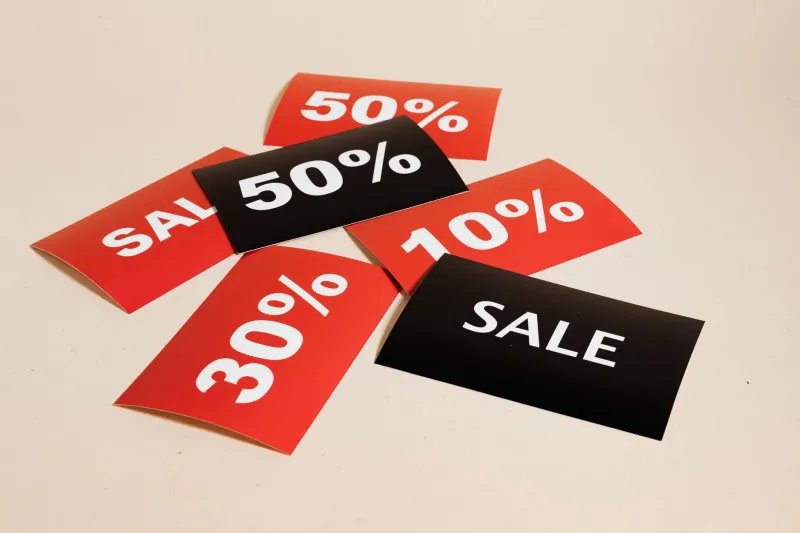
Black Friday 2026 is still a fortnight away, but the high street has already started talking in stickers. One window says 50% off. A smaller card underneath says an extra 50% off at the till. Put them together and a hopeful part of your brain whispers: that's 100% off. Free coat. Maybe free everything.
The till disagrees. And the till is right.
The sign adds. The shop multiplies.
A percentage discount is not a number you subtract from another percentage. It is a multiplier applied to a price. If something is 50% off, you pay 50% of the original — a multiplier of 0.5. If the reduced price then gets another 50% off, you pay 50% of that reduced price. So the final price is:
original price × 0.5 × 0.5
Which is original price × 0.25. You pay a quarter. The total saving is 75%, not 100%.
On an £80 coat, the first sticker takes £40 off, leaving £40. The second sticker takes 50% off £40, which is £20. Final price: £20. A big saving, yes. But the second 50% was not 50% of the original £80. It was 50% of the already-shrunken £40.
That is the whole trap. The second discount is real, but its base has changed.
One formula for a whole window of stickers
Let the first discount be d₁ and the second be d₂, written as decimals. A 30% discount is 0.3, so the pay multiplier is 1 − 0.3 = 0.7. Stack two discounts and the final price is:
P = P₀(1 − d₁)(1 − d₂)
The effective discount is:
D = 1 − (1 − d₁)(1 − d₂)
This works for three stickers too. Keep multiplying the pay fractions. A 20% discount, then 10%, then 25% off leaves you paying 0.8 × 0.9 × 0.75 = 0.54 of the original — an effective 46% off. Not 55%.
The 'extra 20%' question
Shops love the phrase 'extra 20% off'. It sounds like a bonus bolted onto the first discount. Algebraically, it is just another multiplier: 0.8.
Suppose a £100 item has 30% off, then an extra 20% off the reduced price. You pay:
£100 × 0.7 × 0.8 = £56
The effective discount is 44%, not 50%. A straight half-price deal at £50 would be better by £6.
But the same extra 20% can be generous if the first discount is deeper. At 40% off, then an extra 20%, you pay £100 × 0.6 × 0.8 = £48. That is 52% off — £2 better than a straight 50% reduction.
So 'extra 20% off' is not automatically good or bad. It depends on what it is extra to. The useful question is not 'how big is the second sticker?' but 'what fraction of the original price am I still paying?'
A quick comparison table
For a £100 item, here is what the stickers actually do:
| Offer | You pay | Effective discount |
|---|---|---|
| 30% off, then extra 20% | £56 | 44% |
| 40% off, then extra 20% | £48 | 52% |
| 50% off, then extra 20% | £40 | 60% |
| 50% off, then extra 50% | £25 | 75% |
| Straight 50% off | £50 | 50% |
Notice that 50% off then extra 20% beats a straight 50% off. But 30% off then extra 20% does not. The first discount has to be deep enough to make the second one worthwhile.
We can even find the break-even point. When does an extra 20% off beat a straight 50% off? Solve:
(1 − d) × 0.8 < 0.5
1 − d < 0.625
d > 0.375
So the first discount needs to be more than 37.5% for the extra 20% to beat half price. At exactly 37.5%, both deals land at the same final price. Below that, the straight 50% is better. That is a genuinely useful number to carry around in your head during a sale.
Order doesn't matter. Bases do.
Multiplication is commutative, so 30% then 20% gives the same final price as 20% then 30%. The shop can apply the stickers in whichever order it likes. What matters is that each percentage is taken from the current price, not the original one.
This is where mental arithmetic often slips. If you see '£60, 25% off, then an extra 10% off', you might be tempted to add 25% and 10% and call it 35% off. But the real calculation is:
£60 × 0.75 × 0.9 = £40.50
That is 32.5% off, not 35%. The gap is small here, but it grows as the discounts get bigger. On a £250 jacket with 50% then 30% off, adding gives 80% off; multiplying gives 65% off. That is a £37.50 difference — enough to notice on the receipt.
Read the small card, not just the big one
There is a limit to what algebra can tell you from the pavement. A sign saying 'up to 50% off, plus an extra 20% at checkout' may not apply both discounts to every item. Some lines may be excluded. Some offers may not be combined. The formula assumes both stickers apply to the same original price, which is exactly what the small print is there to clarify.
So before you join the queue, check three things: what the first discount applies to, what the second discount applies to, and whether the final price is calculated before or after any other charges. The algebra is only as honest as the numbers you feed it.
The pavement rule
When you see layered discounts, do not add the percentages. Turn each one into the fraction you still pay, multiply those fractions, and compare the result with the single discount you could get elsewhere.
A 50% off sticker followed by another 50% off sticker is not a free item. It is a quarter-price item. A 30% off sticker followed by an extra 20% off is a 44% saving, not a 50% one. And an extra 20% only beats half price once the first discount passes 37.5%.
That is the algebra of the high street in one sentence: the stickers add up in your head, but the shop multiplies them at the till. Keep the multipliers on your side and the window display starts telling the truth.