Second Urn, Second Thoughts: The Hot Chocolate Maths Behind a Christmas Market Upgrade
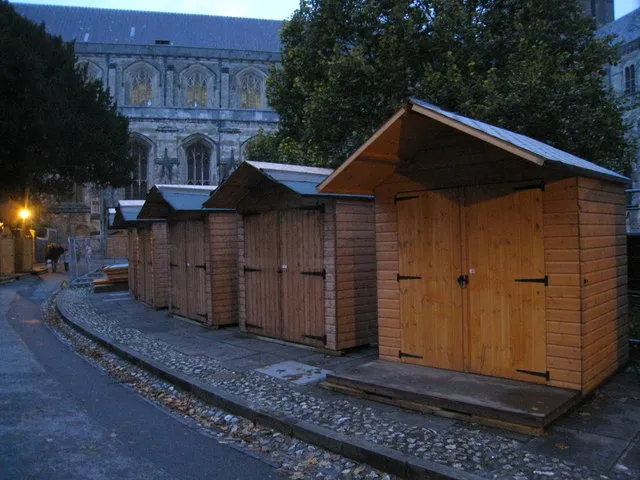
Photo: Sebastian Ballard, CC BY-SA 2.0, via Wikimedia Commons
The queue at the hot chocolate stand is not a queue. It is a visible cost curve.
You are three evenings into a UK Christmas market — think Birmingham's Frankfurt market, Manchester's wooden sheds, a churchyard in Bath — and the same thing happens at 6.15pm. The 20-litre urn is pouring at full tilt. The card machine is beeping. Someone in a bobble hat asks whether the marshmallows are vegan. And you are wondering whether a second urn would pay for itself before the mince pies run out.
It might. But not because queues feel bad. It pays if the extra cups you actually sell clear the extra fixed cost. That is a break-even question, and it has a tidy algebraic answer.
The money that does not move
Assume a 24-day pitch. The pitch fee is £2,400. Public liability insurance is £180. Signage and menus are £120. One urn, a serving table and a power hook-up come to £350. That gives fixed costs of £3,050 for the one-urn setup.
A second urn costs £140. An extra table is £60. A second electrical hook-up and some cable protection is £50. So the upgrade adds £250 of fixed cost. Total fixed cost with two urns: £3,300.
Now the variable side. Per cup, assume cocoa £0.55, milk £0.30, cup, lid and sleeve £0.18, and card fees around £0.07. That is £1.10 per cup. You charge £3.80. Contribution per cup — the bit that goes towards fixed costs — is £2.70.
Two break-even equations, one decision
Let x be the number of cups sold over the season. With one urn, total cost is C1 = 3050 + 1.10x. Revenue is R = 3.80x. Solve 3050 + 1.10x = 3.80x and you get x = 3050 ÷ 2.70 = 1129.6, so 1,130 cups to break even.
With two urns, C2 = 3300 + 1.10x. Solve 3300 + 1.10x = 3.80x and you get x = 3300 ÷ 2.70 = 1222.2, so 1,223 cups.
The gap is 93 cups. That is the number that matters. The second urn does not change the slope of the cost line; it only lifts the intercept by £250. Across a 24-day market, 93 extra cups is 3.9 cups a day. If the second urn wins you four extra cups a day, it has paid for itself. If it wins you two, it has not.
The chart makes the gap visible
Draw cups on the horizontal axis and pounds on the vertical. Revenue starts at zero and rises with a slope of 3.80. The one-urn cost line starts at 3050 and rises with a slope of 1.10. The two-urn cost line starts at 3300, with the same slope. The two cost lines are parallel and £250 apart.
At any given number of cups, the two-urn setup is £250 behind. The break-even chart is less a crystal ball than a ruler: it measures the size of the hole the upgrade has to fill. The upgrade only wins when the extra capacity sells cups that the one-urn setup would have lost.
Capacity is a rate, not a feeling
One urn can serve about 1.1 cups a minute. Two urns can serve about 1.9. During the 6pm rush, demand might hit 1.6 cups a minute. One urn then leaves 0.5 cups a minute of demand unserved; two urns keep up.
If the rush lasts 90 minutes, one urn leaves 45 cups of demand unserved. But not all of those are lost sales. Some people wait, some come back, some walk off to the mulled wine stall. Suppose 20% are genuinely lost: that is 9 cups a day. Over 24 days, 216 extra cups — comfortably past the 93-cup threshold. If only 5% are lost, that is 2.25 cups a day, or 54 cups over the season. Not enough.
So count the walk-offs. A clicker on a Friday night is better than a hunch.
The second pair of hands changes the answer
A second urn may need a second person. If that person costs £12 an hour for four peak hours a day, extra labour is 12 × 4 × 24 = £1,152. Add the £250 equipment and the extra fixed cost is £1,402. Break-even extra cups become 1402 ÷ 2.70 = 519.3, so 520 cups, or 21.7 a day.
Same algebra, new intercept. The queue now has to be properly bad before the upgrade makes sense.
The decision rule
Upgrade if 2.70 × extra cups > 250 + extra labour + extra power. Rearranged: extra cups > (250 + extra labour + extra power) ÷ 2.70. Round up to a whole cup.
In the simple case, the threshold is 93 cups. With staff, it is 520. This is not a guess about whether people like chocolate. It is a threshold you can test against a few evenings of counting.
Before you buy the second urn, watch the queue for three peak nights. If it is costing you more than four cups a night, the algebra is on your side. If not, buy better marshmallows and keep the £250.