Six-Week Cycle, Four Bins: Reading Your Collection Calendar Like a Number Theorist
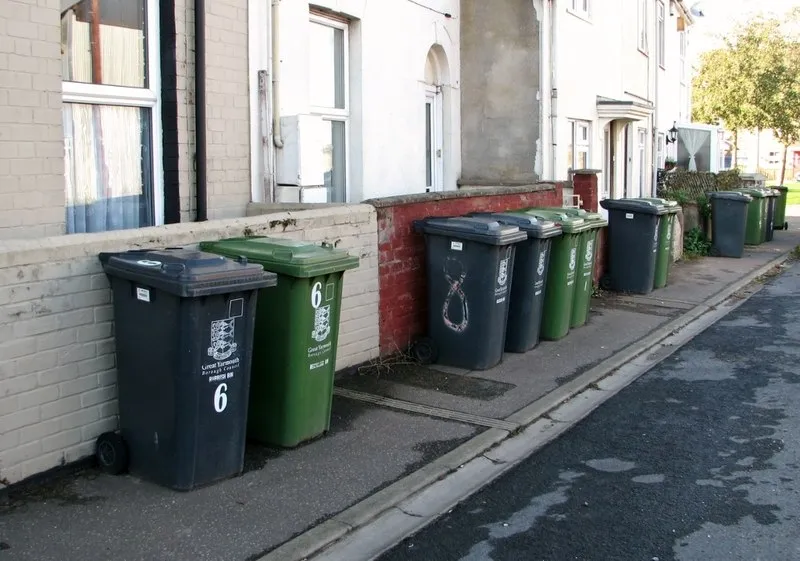
Photo: Evelyn Simak , CC BY-SA 2.0, via Wikimedia Commons
The bin lorry came at 6:52 this morning, which is 40 minutes earlier than the leaflet said, which means the leaflet was describing something other than a time. What it was describing was a cycle. And cycles, unlike times, are things you can actually predict.
Bin day is a remainder, not a date
Pick any day and call it day zero — the Monday you moved in, the first collection after Christmas, whatever you can reliably remember. Now count days since then. If general waste comes every 14 days and it came on day zero, then it comes on every day t where:
t mod 14 = 0
That's it. That's the whole system. t mod 14 is the remainder when you divide the day count by 14, and a collection happens whenever the remainder is zero. This is the same arithmetic as a clock face: at 3pm, the hour hand is where it is because 15 mod 12 = 3. Your bins run on a clock with 14 hours.
No calendar required. No counting forward through the leaflet. Just one division and a look at what's left over.
Assembling the full cycle
A typical metropolitan borough runs something like this — your council will differ, so check the PDF, but the shape is almost always the same.
| Stream | Cycle | Condition |
|---|---|---|
| Food waste | 7 days | t mod 7 = 0 |
| General waste | 14 days | t mod 14 = 0 |
| Recycling | 14 days, offset a week | t mod 14 = 7 |
| Garden waste (subscription) | 21 days | t mod 21 = 0 |
The offset is the interesting bit. General and recycling aren't two independent fortnightly rounds — they're one round with two alternating outputs. Their remainders are 0 and 7, so they can never share a week. Ever. Whatever else happens, those two will always take turns.
When everything goes out at once
The tempting answer is "every 28 days", because 14 and 21 and 7 must all divide something. They don't divide 28. This is where lowest common multiples earn their keep.
For general waste and garden waste to coincide, the day count has to be a multiple of both 14 and 21. LCM(14, 21) = 42. So it happens every 42 days — six weeks — not every four.
Because recycling sits seven days off general waste, it gets its own collision with garden waste on the opposite six-week beat. Which means the week when the whole street looks like a container port isn't once a year. It's roughly eight or nine times a year: garden plus general one fortnight, garden plus recycling the next, and food waste out on every single one of them because 7 divides everything.
Add a four-weekly bulky waste round and the period doubles to LCM(14, 21, 28) = 84 days, because 28 brings a factor of four that 14 and 21 don't have.
Bank holidays and the shift that never resets
Here's where it gets genuinely useful. A bank holiday doesn't cancel a collection; it adds an offset. If your normal day is Monday and the Monday is a holiday, collections run a day late — so the condition becomes:
t mod 14 = 1
And the crucial detail: it stays at 1. The offset carries forward until the council deliberately resets it, which is why your bin day can be a Tuesday for six months after Easter and then quietly revert. Model it as a constant k in t mod 14 = k, and you'll never be caught out again.
There's a second trap. Councils in England and Wales have eight bank holidays a year, but Scotland's pattern is different, and some authorities shift the entire week rather than a single day. Others run a Saturday catch-up round and don't shift anything. Three plausible policies, three completely different offsets, one shared leaflet design.
And note the corollary that catches people out every August: if the holiday falls on a Monday and your collection is a Tuesday, your collection is very probably unaffected. Check whether you are on the shifted day before you drag four containers to the kerb at dawn.
The month trap: 26, not 24
A fortnightly collection feels like twice a month. It isn't. 365 ÷ 14 = 26.07, so you get roughly 26 collections a year, not 24. Two whole extra bin days hide in the gap between the 14-day cycle and the calendar month, and they drift a little further every year because 14 doesn't divide 365.
Garden waste on a 21-day cycle manages about 17 collections a year, while feeling like it should be 12. Your council knows this. It's on the invoice.
Doing it yourself in thirty seconds
- Find one date you're certain about — an actual collection you definitely saw happen.
- Count the days between then and today. Your phone's date calculator will do it; don't count by hand.
- Divide by the cycle length and note the remainder.
- If the remainder is zero, the bin is going out tonight. If it's 1, it went yesterday.
- Repeat with the offsets for the other streams, and write the four remainders on a sticky note on the fridge.
Many councils now publish an .ics feed you can subscribe to, which is the same arithmetic done for you and then hidden behind a button. Use it. But it's worth knowing what it's doing, because the feed is only as good as the council's own reset date — and when a round gets reorganised mid-year, the sticky note is often ahead of the app.
Why councils think in cycles
Rounds are fixed assets: a lorry, a crew, a route. Fixed costs get spread across whatever the round can carry, and a repeating interval is the cheapest possible schedule to administer. Set the period once, print the calendar, and let the remainder do the rest.
The leaflet in your drawer isn't really a list of dates. It's a modulus with a picture on it. Once you see that, bin day stops being an unpredictable event and becomes a small piece of number theory that turns up outside your house every other Tuesday.