Three for £3.50? Put Your Lunch Deal Through the Algebra Test
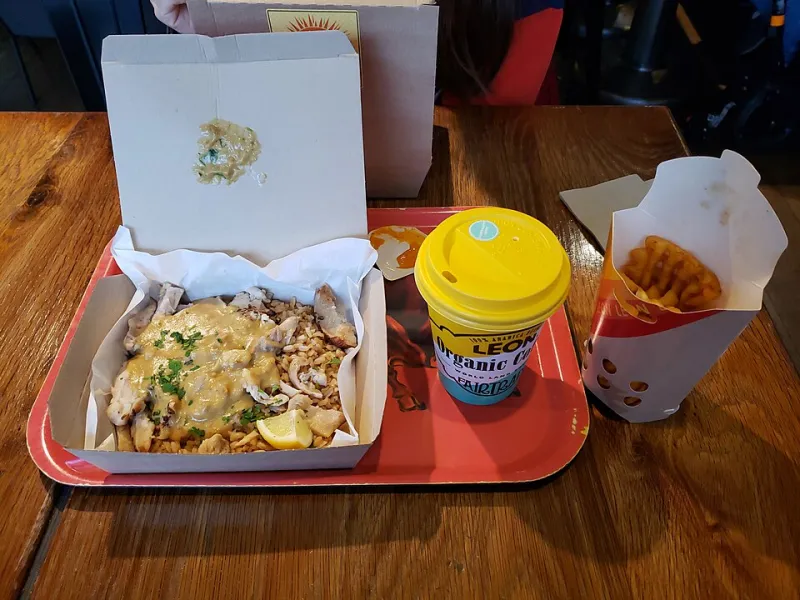
Photo: Andy Li, CC0, via Wikimedia Commons
Walking down any UK high street at half twelve, you meet the same promise: pick a main, a snack and a drink, pay one fixed price. In 2026 the sticker might say £3.50, £3.60 or something else, but the maths is the same. The meal deal is not really a discount. It is a tiny system of equations wearing a plastic sandwich box.
1. Set your baseline before you queue
The useful question is not 'is £3.50 cheap?' It is 'is £3.50 less than what I would otherwise spend?' That sounds obvious, but most of us skip the baseline and go straight to the sticker.
Let m be the shelf price of the main, s the shelf price of the snack and d the shelf price of the drink. Let P be the meal-deal price. In the classic £3.50 case, P = 3.50. If you genuinely want all three items, the deal value is V = m + s + d. The gain is G = V - P.
If G is positive, the deal wins. If G is zero, it is a tie. If G is negative, you have paid more for the privilege of a cardboard carrier bag and a forced snack. That last case is rarer than the supermarkets would like you to think, but it is not impossible: basic own-brand items can add up to less than the deal price.
2. Write the meal-deal equation
Here is a simple example. A main is £2.80, a snack is £1.20 and a drink is £1.60. That gives V = 2.80 + 1.20 + 1.60 = 5.60. The deal price is £3.50, so G = 5.60 - 3.50 = 2.10. You are £2.10 up, assuming you actually wanted all three things.
Now try a leaner lunch: main £2.00, snack £0.70, drink £0.70. Then V = 3.40 and G = 3.40 - 3.50 = -0.10. The deal is ten pence worse than buying the same items separately. It is not a dramatic loss, but it is a useful reminder that 'deal' is a label, not a proof.
3. Compare unit prices, not just totals
The deal hides unit prices. A snack might be a 45g bag at £1.20, while a bigger 150g bag is £1.80. The smaller bag is cheaper on the sticker, but the bigger bag is better value per gram. You can write that as an inequality: compare s divided by weight. If 1.20/45 is greater than 1.80/150, the small bag is the expensive habit.
The same goes for drinks. A 500ml bottle at £1.60 is 0.32p per 100ml. A 1.5-litre bottle at £2.40 is 0.16p per 100ml. The deal might still be convenient, but convenience is a cost too. Algebra does not decide whether you want the bigger bottle. It just shows you what you are paying for the smaller one.
4. Run the swap test
Inside the deal, swapping one snack for another leaves the price fixed and changes the value. If snack A has a shelf price of £1.20 and snack B has a shelf price of £1.80, choosing B raises V by £0.60. Same £3.50, more paper value. That is the swap test in one line.
But price is not the same as value. If you would never pay £1.80 for snack B, counting the full £0.60 as a win is optimistic accounting. A better measure uses what you would actually pay: w_m + w_s + w_d - P, where w stands for willingness to pay. If the deal nudges you into a snack you did not want, the shelf price is not a saving. It is a nudge with a barcode.
5. Solve the skip-the-snack inequality
Sometimes you want only a main and a drink. Then the snack is not a bonus; it is clutter. Compare the separate price of the two items you actually want with the deal price. If m + d is less than P, buy them separately. If m + d equals P, the deal gives you a free snack, provided you will eat it. If m + d is greater than P, the deal is cheaper and the snack is genuinely extra.
Take a main at £2.60 and a drink at £1.20. That is £3.80 separately, so the £3.50 deal saves you 30p and throws in a snack. Now take a main at £1.80 and a drink at £1.10. That is £2.90 separately. Paying £3.50 is not a bargain; it is a 60p donation to the supermarket's snack division.
6. Watch the premium-item trap
Some meal deals exclude premium sandwiches, or charge an extra x for them. The new price is P + x, not P. The bargain condition becomes m + s + d > P + x. If the premium main adds £1.00, you need at least £4.50 of shelf value before the deal is doing anything useful.
The quieter trap is the extra item you did not need. If you only wanted a main, a deal can turn a £2.50 lunch into a £3.50 lunch plus a snack you eat because it is there. The algebra of the deal says you saved money on the basket. The algebra of your actual hunger says you spent an extra pound and added 250 calories. Both equations are true. Only one is about lunch.
7. A three-line check you can do at the shelf
First, add the shelf prices of the exact items you want. Second, subtract the deal price. Third, ask whether you would buy every item without the sticker. If the answer is yes and the number is positive, the deal is a bargain. If the number is negative, or if the snack is only there because the deal made you take it, walk to the till separately.
That is the meal deal equation in its simplest form. It is not a rule that says deals are bad. It is a rule that says the deal is one option among several, and the numbers are allowed to disagree with the marketing. At £3.50, the difference between a bargain and a bad habit can be less than a pound. Algebra is just the receipt you write before you pay.