The Token and the Tumble: A Laundrette Queue Solved by Rates
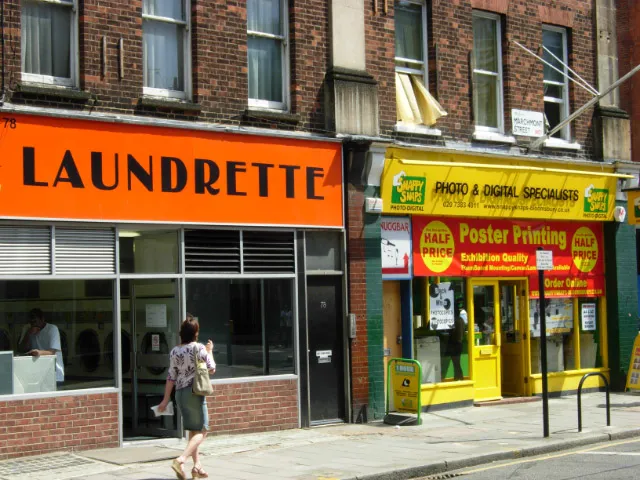
Photo: Stephen McKay, CC BY-SA 2.0, via Wikimedia Commons
Saturday afternoon, the high street is doing its best impression of a car wash, and the laundrette is full. Six baskets are lined up on the plastic chairs. One tumble dryer is turning. You have a token, a damp duvet, and a decision to make before you feed the meter.
The queue looks like a mystery. It is actually a rate problem. Once you know the cycle time and the changeover time, the whole thing collapses into a linear equation. That equation will not dry your washing, but it will tell you whether to wait, walk to the next laundrette, or come back later.
The service time is the hidden number
The dryer runs a 24-minute cycle. That is the advertised number. The real service time is longer, because somebody has to unload, reload, and feed the meter. Call that changeover h = 3 minutes. The service time per load is
S = C + h = 24 + 3 = 27 minutes.
The throughput is one load every 27 minutes, or
R = 60 / 27 ≈ 2.22 standard loads per hour.
That is the rate. Six baskets is not six times a 24-minute cycle; it is six service slots of 27 minutes, with the last one finishing before its changeover.
The queue equation
Let L be the number of standard loads ahead of yours. If your basket is the last of six, then L = 5. Your load is number L + 1. It finishes after (L + 1) cycles and L changeovers:
F = (L + 1)C + Lh.
With C = 24 and h = 3:
F = 6 × 24 + 5 × 3 = 144 + 15 = 159 minutes.
That is 2 hours 39 minutes. If your basket is fourth in the queue, L = 3, and F = 4 × 24 + 3 × 3 = 105 minutes, or 1 hour 45. The difference between fourth and sixth is nearly an hour. Queue position is not a detail; it is the whole equation.
If some baskets are small, convert them to standard loads. A single duvet might count as 1.5; a handful of T-shirts might count as 0.5. Add those equivalents to get L_eff, then use the same formula. The dryer does not care how many baskets there are, only how many loads it has to run.
Waiting, walking, or coming back
Now compare the options. The first laundrette has one dryer and five loads ahead of yours. The second is an 11-minute walk away, has three dryers, and two baskets ahead. The third option is to go home and come back at 16:00, when the Saturday rush should have thinned out.
Option A: wait. Time until your laundry is dry: 159 minutes. Cost: one £3 dryer token.
Option B: walk. Walk there 11 minutes, wait for a free dryer — say 5 minutes — then run a 24-minute cycle, then walk back 11 minutes. Total: about 51 minutes. Cost: £3.50 token plus shoe leather.
Option C: come back later. Go home 15 minutes, return 15 minutes, and join a queue of two baskets. From the moment you return, your finish time is (2 + 1) × 24 + 2 × 3 = 78 minutes. If you spend the gap doing something useful, the active cost is lower, but the elapsed time is higher.
The comparison is not just queue length. It is total time and total cost. If your time is worth £10 an hour, waiting 2.65 hours costs about £26.50 in opportunity cost. Walking for 51 minutes costs about £8.50, plus the extra 50p token. The walking option wins on the maths, provided the second laundrette actually has a free dryer when you arrive.
The inequality behind the decision
You can write the choice as an inequality. Let T_wait be the finish time at the first laundrette, T_walk the finish time at the second, and Δc the extra money the second costs. Walk if
T_wait − T_walk > Δc / v,
where v is your value of time in pounds per minute. With T_wait = 159, T_walk = 51, Δc = 0.50, and v = 10/60 ≈ 0.167 pounds per minute, the right-hand side is about 3 minutes. The time saving is 108 minutes, so the inequality is comfortably true. Walk.
If the second laundrette were 40 minutes away, or if the queue there were eight baskets, the answer could flip. That is the point of the equation: it lets you change the numbers and see what happens.
The damp winter conclusion
A laundrette queue is a rate problem with a coin slot. Count the standard loads ahead of you, add the changeover time, and divide by the number of dryers. Then compare the total time of each option, not just the length of the line. In winter, when every duvet on the high street is damp, the queue is long but the maths is short. Feed the meter only after you have solved it.