Twelve-Fifty a Day: The Clean Air Zone Sum That Decides Whether You Keep the Car
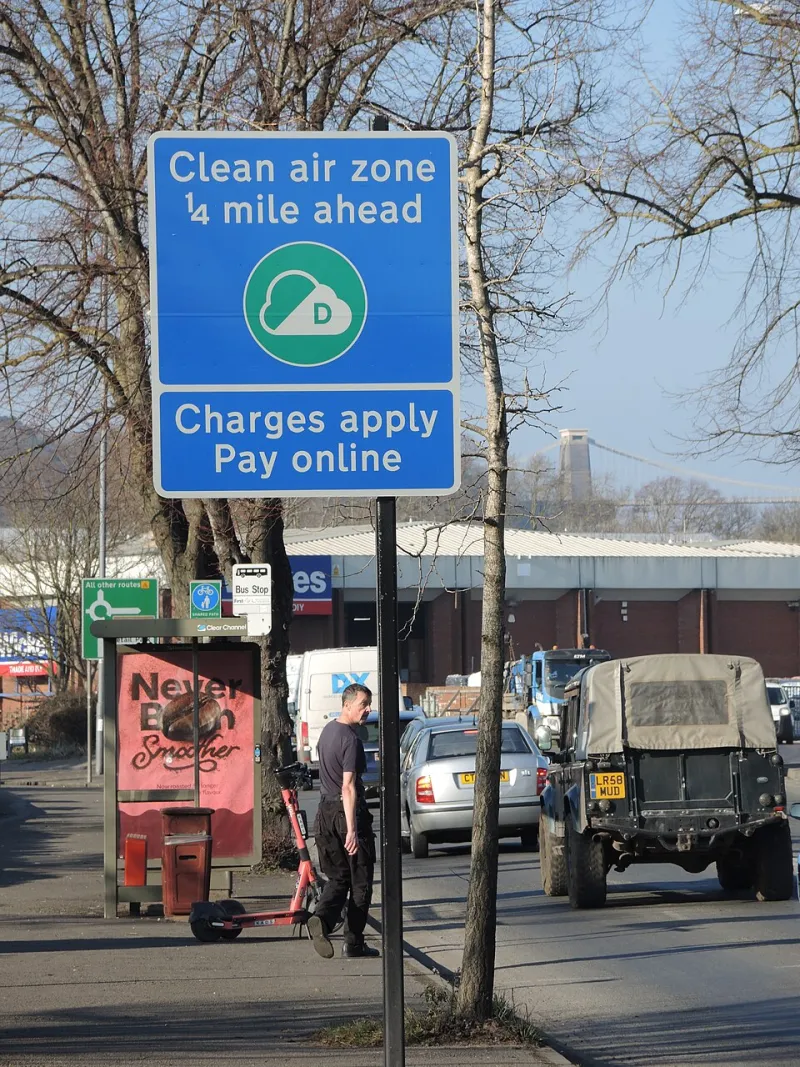
Photo: Neil Owen , CC BY-SA 2.0, via Wikimedia Commons
The letter from the council is short and unsentimental. Your car doesn't meet the emissions standard, and from now on entering the zone costs money — on every day you drive in.
Most people read that and file it under 'monthly bill'. It isn't a bill. It's a straight line, and once you sketch it you can see precisely where the crossover sits between paying the charge and paying for a different car. And the crossover moves a very long way depending on whether you're in the zone twice a week or twice a day.
One charge, one gradient
Let d be the daily charge and n the number of days you actually drive into the zone in a year. Your annual outlay is:
C = d × n
That's the whole model. No standing charge, no tier, no loyalty discount. A line through the origin with gradient d. Charges for cars and vans in English schemes commonly sit somewhere in the £8 to £12.50 a day range, with much steeper numbers for lorries and coaches; check your own scheme rather than trusting a figure from a friend. For the sums here we'll use £12.50, because it's easy arithmetic and it's at the sore end.
Two hundred chargeable days a year is £2,500. Two hundred and forty is £3,000. Notice what the gradient does: every extra day in the zone costs exactly the same as the last one. There is no bulk discount for being a heavy user, which is the first hint that the charge bites hardest at the people who drive most.
Doing the sum on a real commute
Say you work inside the zone five days a week, take five weeks off, and pop in on a handful of Saturdays. Call it 240 chargeable days.
- Annual charge: 240 × £12.50 = £3,000
That £3,000 is the number to beat. Not the monthly figure, not the price of a tank of diesel — the annual total, because you're comparing it with a purchase.
The other side of the ledger
Now the compliant car. Suppose a replacement costs £9,400, your current car would fetch £2,600 in a private sale, and insurance on the newer vehicle adds around £300 a year. Ignore finance for a moment and treat the capital gap as the entry fee:
- Net capital outlay: £9,400 − £2,600 = £6,800
- Plus the first year's insurance difference: £7,100
The break-even inequality is where the charges stop being the cheaper option:
d × n > P − R + E
where P is the purchase price, R the resale value of your old car, and E any extra running cost you're taking on. Divide both sides by d and you get the number of chargeable days you need to burn through before switching wins:
n > (P − R + E) ÷ d
For our driver: £7,100 ÷ £12.50 = 568 chargeable days. At 240 days a year, that's roughly two years and four months of driving into the zone before the new car has paid for itself. If the current car has five solid years left in it, the arithmetic says switch. If it's on its last legs anyway, the decision has nothing to do with the zone at all.
Why the occasional driver gets the opposite answer
Same city, same charge, different life. A driver who enters the zone twice a week for 46 weeks clocks up 92 chargeable days.
- Annual charge: 92 × £12.50 = £1,150
Same £7,100 to switch, so the break-even is 568 ÷ 92, which is more than six years. If that car has four years of life in it, paying the charge is comfortably cheaper than replacing it — and that's before you've counted the interest on a car loan.
This is the bit the headlines miss. The clean air zone isn't expensive or cheap in the abstract. It's a function, and its output depends entirely on the value you feed in for n.
Four things that bend the straight line
The charge is per day, not per trip. Two journeys into the zone on the same day cost one charge. If you can bunch errands, your cost per trip halves and your effective gradient drops. A driver making four trips on each of 60 days pays £750 a year — £3.13 a trip rather than £12.50.
The clock resets at midnight. A delivery at 23:50 and another at 00:10 count as two days. Round the edges of your week carefully.
Forgetting turns a line into a step. Miss a payment and the penalty charge notice lands — often £120, halved if paid promptly, which is ten days of charge in one go. Set up auto-pay the day you register.
Exemptions and discounts vary wildly. Blue badge holders, vehicles in the disabled tax class, historic vehicles over forty years old, and motorcycles are treated differently from scheme to scheme, and some cities offer resident discounts. Scotland is a different animal entirely: its low emission zones are penalty-only, with no daily charge to pay at all. Read your own scheme's rules before you build the model — a single exemption can send d to zero and the whole inequality collapses.
The cost of waiting isn't zero either
One more wrinkle. Your non-compliant car is depreciating while you decide. If it loses £700 a year in value, delaying the swap by twelve months means you pay £3,000 in charges and get £700 less for the car. Comparative statics like this are worth doing on the back of an envelope: total cost of keeping = charges over the period + drop in resale value. Total cost of switching = capital gap today. Whichever envelope is lighter wins.
Your five-minute version
- Count your realistic chargeable days for a year. Be honest, not optimistic.
- Multiply by the daily charge. That's your annual line.
- Price a compliant replacement, subtract what your car would sell for, add any insurance or servicing difference.
- Divide step 3 by the daily charge to get break-even days.
- Divide again by your annual days to get break-even years, and compare it with how long you actually plan to keep the car.
None of this tells you what to feel about clean air policy. It tells you what the numbers do, which is a different and rather more useful thing. And the answer is genuinely different for a rep doing 240 days a year and a retired couple doing 40 — same street, same sign, same charge, two entirely separate graphs.