Salt Doesn't Need to Be Everywhere: The Covering Maths Behind a Gritting Route
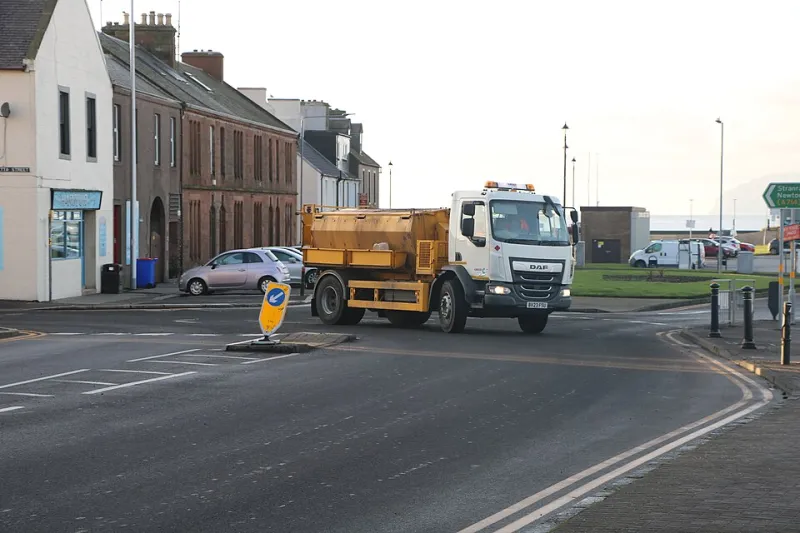
Photo: Billy McCrorie , CC BY-SA 2.0, via Wikimedia Commons
6:42am, and the road outside is still white
You hear it before you see it: the low diesel growl of a gritter working the main road, amber lights smearing across the frost. Ten minutes later the school run begins and your side street is still an ice rink. The natural question is: why didn't they just do ours too?
The answer is less sinister than it feels. A winter gritting route isn't a list of streets the council likes. It's a solution to a small, brutal optimisation problem — one that mathematicians call set cover. And like every optimisation problem, it has an objective, constraints, and a set of things it has decided not to care about.
What a gritter is actually choosing
Picture the borough map as a graph. Each road segment is an edge; each junction is a node. The council doesn't salt every edge. It salts a subset — call them the chosen segments — and the salt bin at the depot has to stretch across several runs.
The things that must be covered are the obligations: the primary school gate on Mill Lane, the bus stop where the 07:42 picks up, the GP surgery at the top of Beech Road, the steep hill that iced over last February, the ambulance route to the hospital. Each obligation sits on or beside one or more segments. A segment 'covers' an obligation if salting it gives safe access to that point.
Now give every segment a binary variable: 1 if the gritter salts it, 0 if not. The council's problem is roughly:
minimise x₁ + x₂ + x₃ + x₄ + ... subject to: for every obligation, the sum of variables on the segments that cover it is at least 1.
That last line is the whole trick. It says: every school, bus stop and surgery must be touched by at least one salted segment. It does not say every street must be salted. That's not a loophole; it's the definition of coverage.
Four streets, three obligations
Take a toy version. Suppose the priority list has three obligations: the school on Mill Lane (covered by segment A), the surgery on Beech Road (segment B), and the bus stop on Station Approach (segment C). Your street is segment D. It joins A at one end, but it covers no obligation on the list.
The constraints are:
A ≥ 1 B ≥ 1 C ≥ 1
The objective is to minimise A + B + C + D. The solution is A = B = C = 1, D = 0. Your road stays white. Not because the model is broken — because you asked it to cover schools and bus stops, and it did.
This is the point where most of us start muttering about fairness, and we're right to. The model is doing exactly what it was told. The question is whether the brief was wide enough.
The greedy shortcut (and why junctions win)
In real life the council doesn't solve a perfect integer programme over breakfast. It uses a heuristic: start with the uncovered obligations, pick the segment that covers the most of them per pound spent, cross those obligations off, repeat. Ties go to the steeper hill, the busier road, the one that serves the hospital.
This is why junctions get salted and cul-de-sacs don't. A segment through a junction touches several obligations at once. Your street touches one house and a wheelie bin. In set-cover language, it has poor coverage density. In council language, it doesn't make the cut.
The greedy method isn't optimal, but it's fast, explainable, and close enough for a 4am start. The catch is that it systematically favours segments with many obligations, which often means main roads — and main roads are exactly where the buses and schools already are.
Putting fairness back in as a constraint
If you want your street salted, you don't need a better algorithm. You need a different constraint. For example: every residential address must be within 300 metres of a salted segment. Or: every street used by a care worker on a morning call must be covered. Or: no street with a gradient above 10% may be left out.
Add one of those lines to the model and the answer changes. Segment D might flip to 1. But something else has to give: another segment gets dropped, or a second gritter run is added, or the salt budget rises. That's the honest trade-off. Coverage is a budget decision disguised as a road decision.
What the map won't tell you
Councils publish gritting routes and salt-bin locations, and they're worth reading before the next cold snap. You'll often find that your street is 'secondary' — treated after the priority network is clear, if at all. You'll also find the salt bins, which are a low-tech version of the same idea: put coverage where people can reach it.
The algebra doesn't make your road any less icy. But it does give you the right question. Not 'why didn't you salt my street?' but 'what obligations did you choose to cover, and what would it cost to add mine?' That's a question a council can actually answer — and a set of constraints you can argue with.